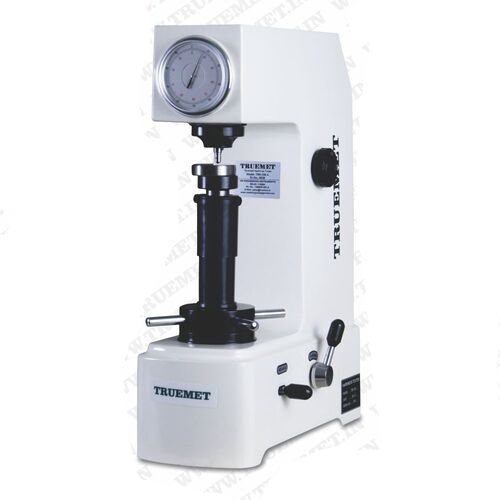
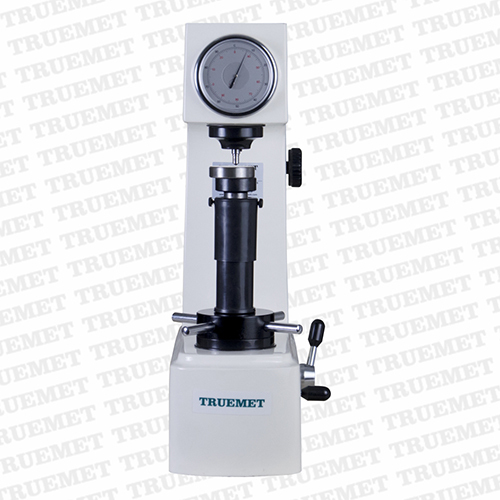
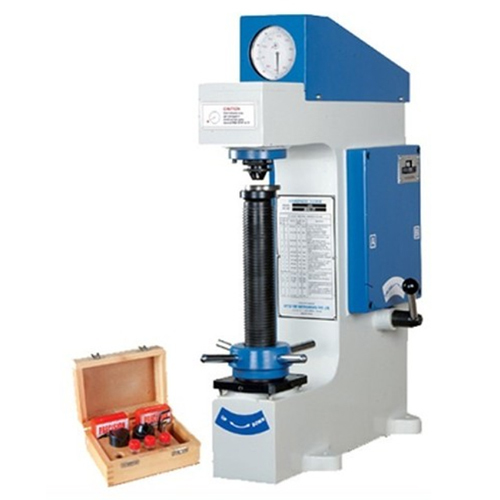
About Analogue Rockwell Hardness Tester
FEATURES
1. Decent design, high testing precision and simple operation.
2. Adopted car painting technology. The paint shade do not fade and machine looks like new over year.
3. The Elevating screw is guided in a hardened & ground bush, not allowing movement of elevating screw more than 0.05mm when raised to full height.
4. An antifriction linear movement with almost no clearance is provided for a perfect movement of diamond holder. this enable testing of small dia. pin or ball upto 3mm dia.
5. The machine provided with manual zero setting dial indicator having least count of 0.5 HR and automatic load selection by knob.
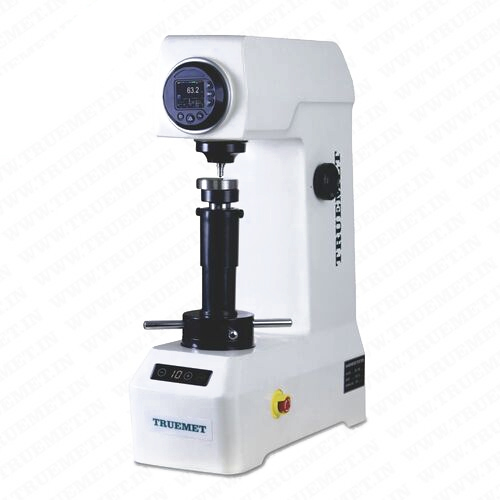
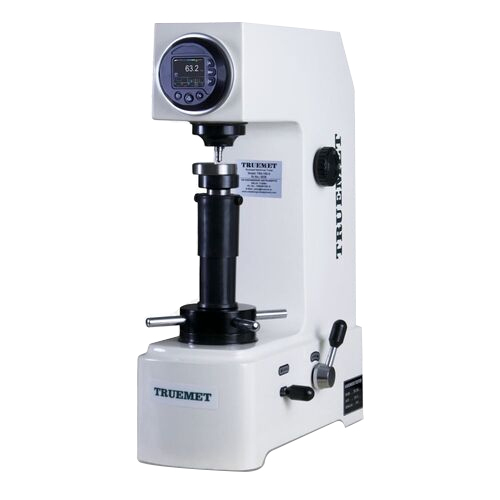
6. The machine can be upgraded to digital by replacing with digital dial indicator (optional).
Premium Build and ComplianceThis Rockwell Hardness Tester features a powder-coated, corrosion-resistant body and is engineered for consistent accuracy as per IS:1586-2000 and ASTM E-18 standards. Its design assures durability, while the overload protection function safeguards both operator and equipment.
Versatile Hardness Testing CapabilityWith interchangeable diamond and ball indenters, the tester is adept at handling various metals and alloys. The 150 mm test table diameter accommodates diverse specimen sizes, enabling tests within the Rockwell B & C scales for a broad range of applications.
Simple, Reliable OperationThe machine operates manually via a lever and offers immediate hardness readings on a clear analogue dial. A comprehensive accessory kitincluding test blocks, anvils, and spannersensures ease of use right from initial setup to routine testing.
FAQs of Analogue Rockwell Hardness Tester:
Q: How do I use the Analogue Rockwell Hardness Tester for metal hardness measurement?
A: Place your prepared metal specimen (270 mm height, up to 150 mm throat depth) on the test table and select the appropriate indenter. Use the manual lever to apply the initial and major loads as per the required Rockwell scale. The result will be displayed immediately on the analogue dial.
Q: What applications is this hardness tester best suited for?
A: This bench-top Rockwell tester is ideal for laboratories, workshops, and educational institutes. Its designed for precise hardness testing of ferrous and non-ferrous metals and alloys, supporting both Rockwell B and C scales.
Q: What are the benefits of the powder-coated corrosion-resistant finish?
A: The powder-coated, corrosion-resistant finish protects the tester from environmental damage and ensures longevity, especially in busy or harsh industrial or laboratory environments.
Q: Which accessories come with the hardness tester, and how do they enhance its process?
A: The tester includes standard test blocks, diamond and ball indenters, flat and V anvils, spanners, and an instruction manual. These accessories enable immediate testing and maintenance, ensuring wide compatibility with various specimen shapes and sizes.
Q: Is the tester compliant with industry standards?
A: Yes, it strictly complies with both IS:1586-2000 and ASTM E-18 standards, ensuring reliable accuracy and repeatability (0.2 HRC) in hardness measurements.
Q: What safety features are integrated into this equipment?
A: The overload protection mechanism prevents excessive force from damaging the device or affecting test results, promoting operator and machine safety during manual operation.
Q: When is it advisable to use the diamond indenter versus the steel ball indenter?
A: Use the diamond indenter (120 cone) for hard materials and high-range Rockwell C scale tests, whereas the 1/16" steel ball indenter is suitable for softer metals assessed on the Rockwell B scale.

 Send Inquiry




 Send Inquiry
 Send Inquiry