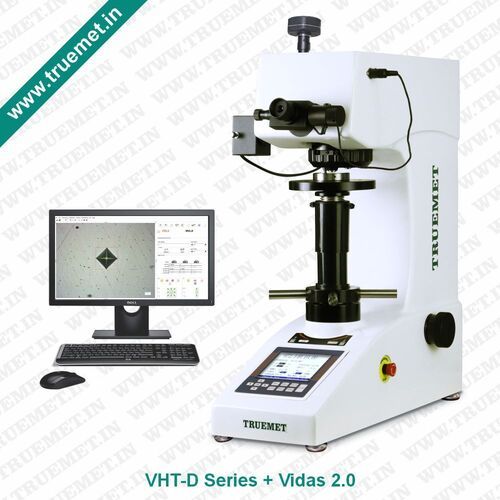
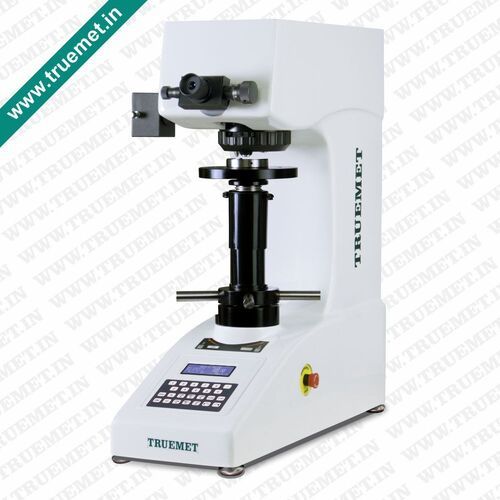
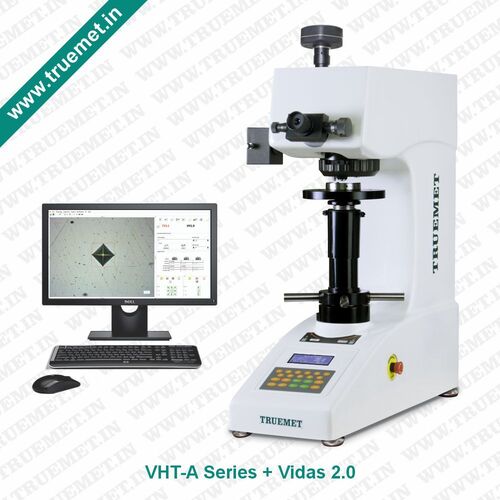
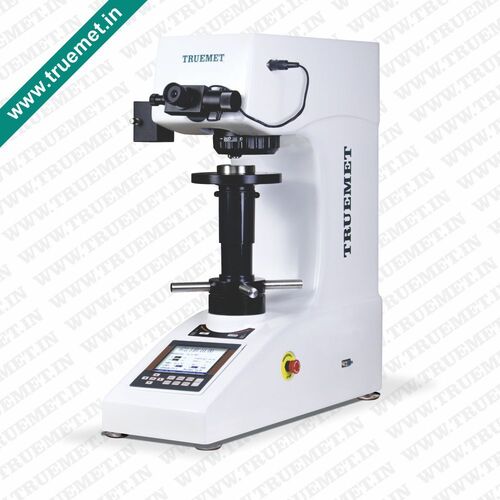
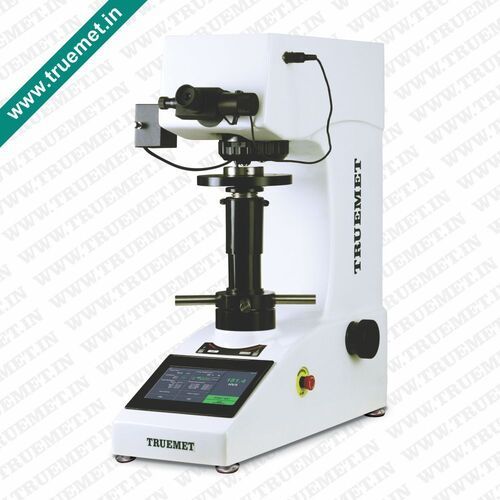
About Computerized Load Cell Based Digital Vickers Hardness Tester (THT-D Series with VIDAS 2.0)
Features
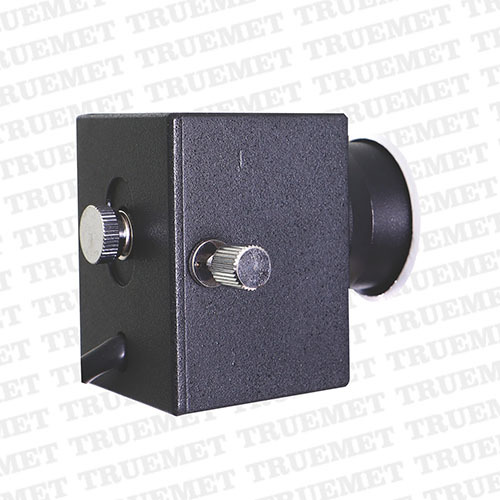
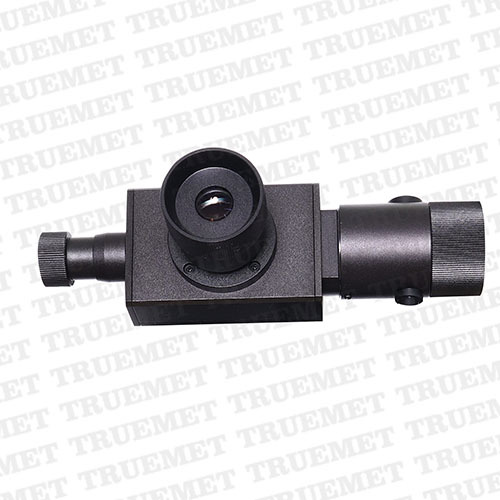
DIGITAL EYEPIECE : Equipped with 10x Digital Eyepiece to directly measure the length of the diagonal. The hardness value can be displayed directly and there is no need to enter the length of the diagonal.
ILLUMINATION SYSTEM : Halogen illumination unit gives very clear images and can be also used as a simple microscope. Halogen illumination unit enter stand by mode after a certain period of inactivity which gives it a long service life and low power consumption.
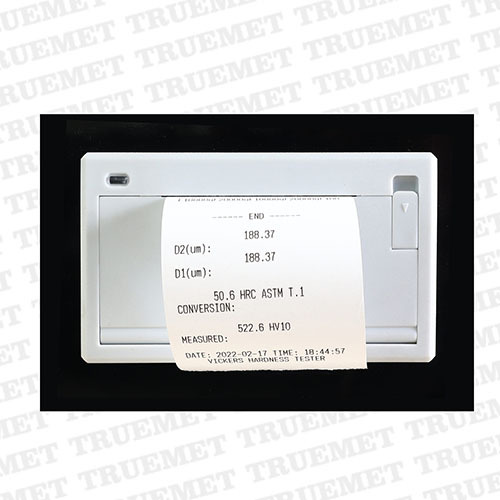
DATA OUTPUT : Equipped with built in thermal printer to take the print out the hardness result.
CAMERA PORT : Machine equipped with dual optical channel. 5 MP USB Camera is connected to one of the dual optical channels, other optical channel is for 10X eyepiece. Both optical channel works simultaneously.
TEST FORCE : All the test force is applied by load cell. The high quality load sensing system can do a wide-range of vickers test by one load cell.
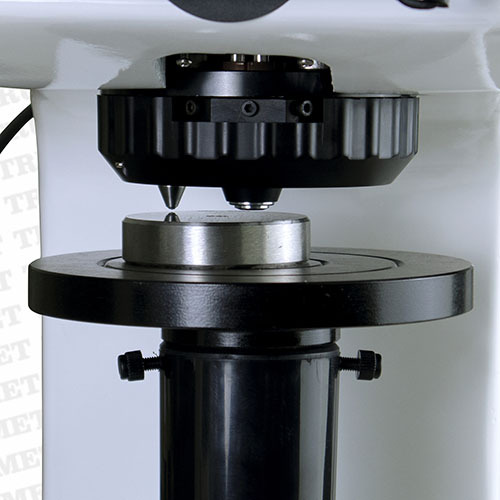
TURRET MECHANISM : Equipped with manual turret mechanism. The position of the indentor and objective lens can be switched manually.
LARGE LCD SCREEN PANEL : 75X100 mm LCD screen can visually display the hardness value, conversion hardness, test force, dwell time, upper & lower limit, max-min, and average value.
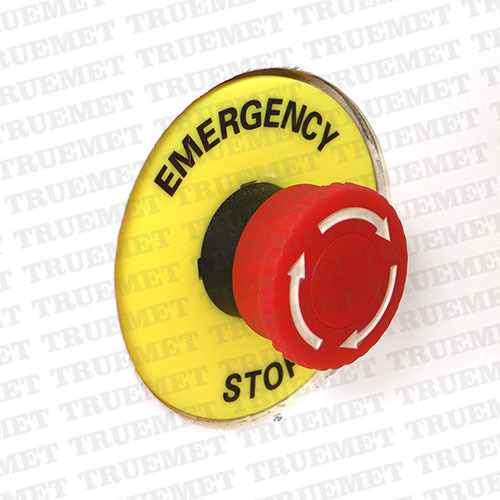
EMERGENCY SWITCH : Equipped with emergency stop switch.
Cutting-Edge Automation for Consistent ResultsExperience fully automated hardness testing with the THT-D Series. The load cell-based force application, electronic closed-loop feedback, and auto-focusing ensure accuracy and repeatability that complies with ISO 6507 and ASTM E384 standards. The touch-enabled VIDAS 2.0 interface simplifies test setup and operation, helping quality and research labs streamline their workflows.
Advanced Imaging and Data ManagementFeaturing a high-resolution optical system paired with a digital camera, the tester facilitates precise indent impression analysis. Automatic measurement, graphic storage, and powerful reporting tools are integrated. Result archiving and image management are easy with internal and external storage support, while direct print and USB export options support seamless data transfer.
Versatile and Robust Hardware DesignThis bench-top instrument can accommodate a broad range of specimen sizes and is compatible with optional accessories such as Knoop indenter and macro stage. The sturdy buildaugmented by overload, overtravel, and power interruption safeguardsenables reliable operation in demanding lab and industrial environments. Fully automated test cycles and motorized specimen positioning increase throughput and versatility.
FAQs of Computerized Load Cell Based Digital Vickers Hardness Tester (THT-D Series with VIDAS 2.0):
Q: How does the THT-D Series Digital Vickers Hardness Tester ensure accurate and repeatable measurements?
A: Accuracy and repeatability are achieved through a computerized, fully automatic load application via a load cell-based electronically closed-loop system. This ensures precise test force application between 10 gf and 1 kgf, with instant (<1s) digital measurement processing. The auto-focusing feature, high-resolution camera, and compliance with ISO 6507 and ASTM E384 standards further elevate measurement quality.
Q: What types of specimens and hardness scales are supported by this hardness tester?
A: The tester is engineered to handle a variety of specimens up to 190 mm in height and 130 mm in depth, making it suitable for single and batch testing. It supports Vickers, micro-Vickers, DPH, and HK hardness scales, and is capable of evaluating metals, ceramics, composites, and similar materials within the 1HV2967HV hardness range.
Q: When is it advisable to use the automatic test cycle and motorized stage?
A: The automatic testing cycle and motorized X-Y stage are recommended when high throughput, consistent positioning, and minimal operator involvement are necessary. These features are particularly beneficial for batch specimen processing, routine quality assurance, and laboratory research that require efficient, repeatable testing.
Q: Where can data and test results be exported or stored from the device?
A: Test results and images can be stored on the instruments large internal memory or exported externally via USB ports or RS232 interface. Additionally, users can print reports directly from the unit or generate detailed documentation using the Windows-compatible VIDAS 2.0 software for comprehensive records and analysis.
Q: What is the process for conducting a hardness test with the THT-D Series?
A: Begin by mounting the specimen on the stage (up to 130 mm wide, 190 mm high), then use VIDAS 2.0 touchscreen or software to select test parameters. The tester automatically applies the selected load, positions and focuses the indenter, and records indentation with the digital camera. Measurements and results are processed and reported instantly, with data available for export or printing.
Q: How does the tester benefit laboratories and industrial quality assurance?
A: By delivering rapid, highly automated, and standards-compliant hardness testing, the THT-D Series reduces human error, saves operator time, and increases throughput. Its robust safety features, software-controlled test protocol, image archiving, and comprehensive reporting make it indispensable for metallurgy labs, industrial QA/QC, and research institutions worldwide.

 Send Inquiry


 Send Inquiry
 Send Inquiry