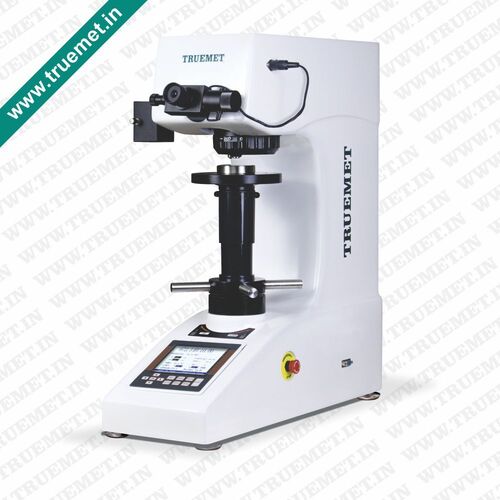
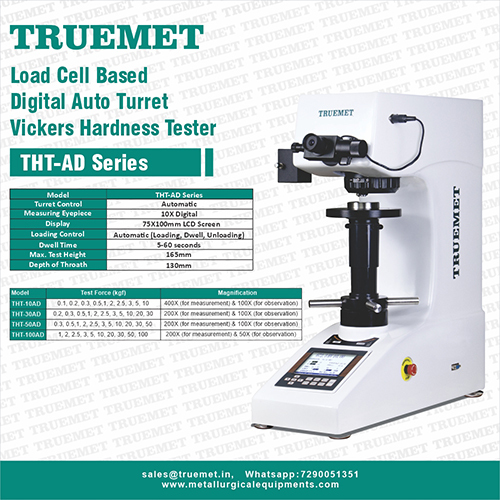
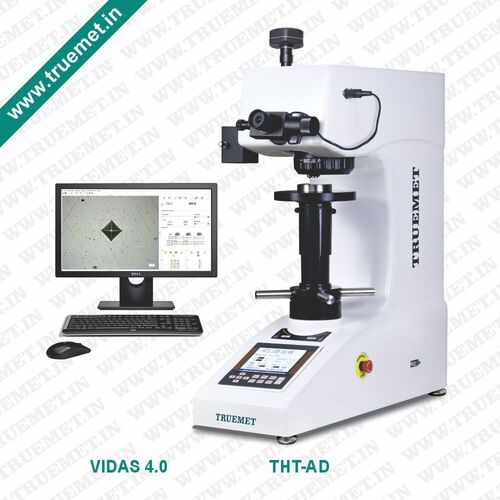
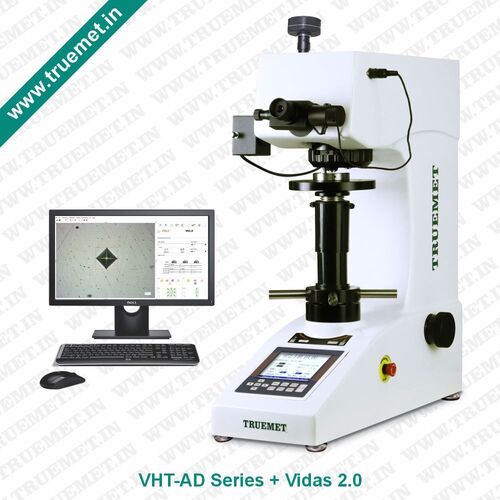
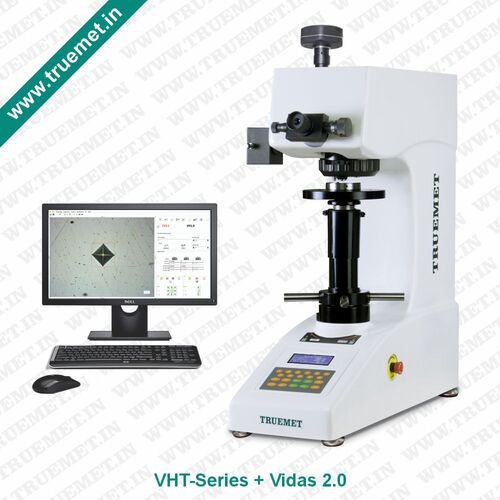
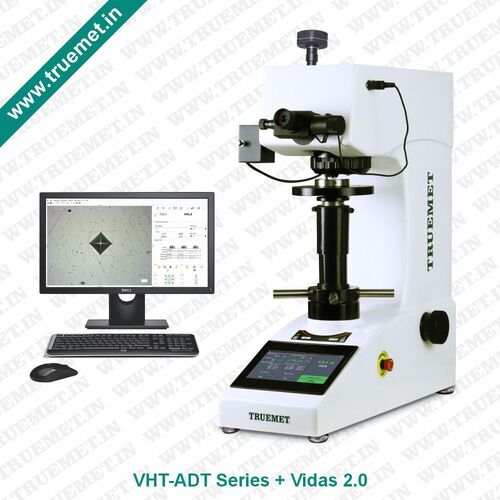
About Load Cell Based Digital Vickers Hardness Tester (THT-AD Series)
Features
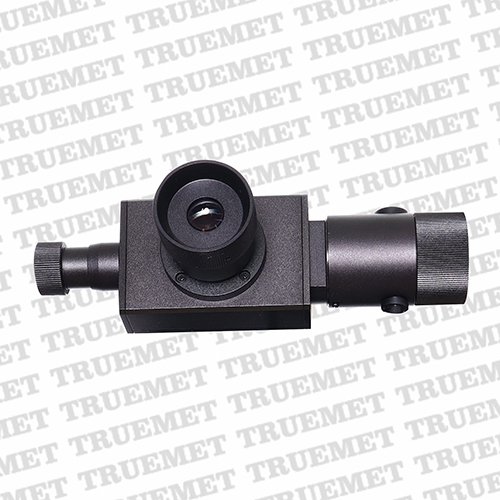
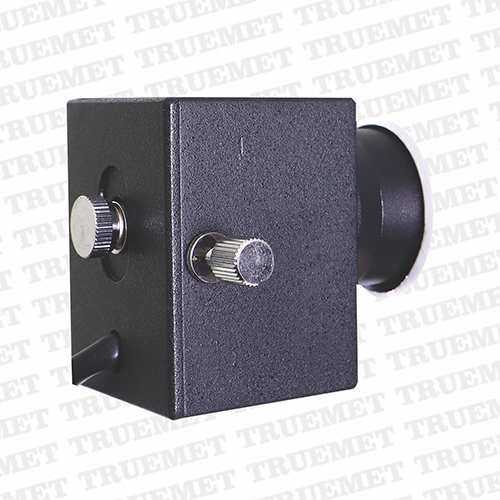
DIGITAL EYEPIECE :Equipped with 10x Digital Eyepiece to directly measure the length of the diagonal. The hardness value can be displayed directly and there is no need to enter the length of the diagonal.
ILLUMINATION SYSTEM :Halogen illumination unit gives very clear images and can be also used as a simple microscope. Halogen illumination unit enter stand by mode after a certain period of inactivity which gives it a long service life and low power consumption.
DATA OUTPUT :Equipped with built in thermal printer to take the print out the hardness result.
CAMERA PORT :Machine equipped with dual optical channel, one optical channel for 10X eyepiece and another optical channel is for camera by which machine can be upgraded into computerized / computer controlled model. Both optical channel works simultaneously.
TEST FORCE :All the test force is applied by load cell. The high quality load sensing system can do a wide-range of vickers test by one load cell.
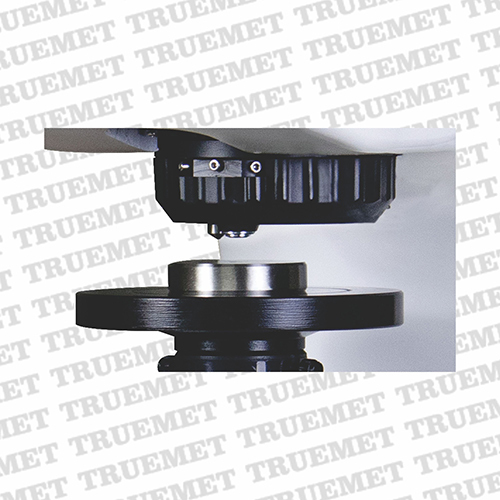
AUTO TURRET MECHANISM :Equipped with auto turret mechanism. Auto turret perform a series of operation and measuring lens automatically comes back to central position after making indentation. The position of the indenter and the objective lens can be automatically switched using touch panel.
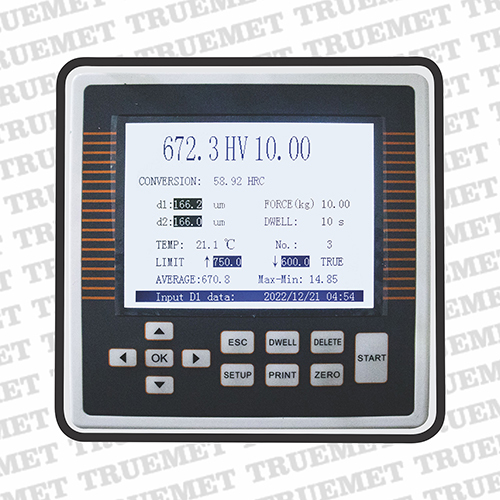
LARGE LCD SCREEN PANEL :75X100 mm LCD screen can visually display the hardness value, conversion hardness, test force, dwell time, upper & lower limit, max-min, and average value.
EMERGENCY SWITCH :Equipped with emergency stop switch.
Precision Hardness Testing for Laboratories and IndustryThe THT-AD Series is engineered for rigorous hardness assessment in metallurgical laboratories and industrial shop floors. Utilizing load cell technology with digital/automatic controls, it delivers reliable and repeatable Vickers hardness values. Users can easily program dwell times (1-99s) and select test loads specific to their material requirements, ensuring versatility for research and quality control applications.
Versatile Operation and Enhanced User ExperienceWith features such as automatic loading/unloading, instant response, and data output options (USB/RS232), this Vickers Hardness Tester streamlines the testing process. Its large, user-friendly touchscreen provides direct digital readouts, statistical analysis, and data storage. Enhanced by precise illumination and manual/automatic X-Y stage movement, it makes specimen examination straightforward and efficient for both single and multiple samples.
FAQs of Load Cell Based Digital Vickers Hardness Tester (THT-AD Series):
Q: How does the load cell feedback system improve the accuracy of the Vickers Hardness Tester?
A: The load cell feedback mechanism ensures that the applied test load is continuously monitored and precisely maintained during indentation. This results in higher accuracy and repeatability of hardness measurements, reducing variability often associated with manual loading systems.
Q: What types of specimens can be tested, and what is the maximum size allowed?
A: The tester accommodates metals, alloys, and ceramics commonly used in metallographic analysis. It supports specimen sizes up to 200 mm in width and 100 mm in height, making it suitable for a broad range of sample types in both lab and industrial contexts.
Q: When should you adjust the dwell time, and how is it controlled?
A: Dwell time (the duration the load is applied) can be set between 1 and 99 seconds, depending on the material under test and industry standards. It is digitally adjustable via the instruments touchscreen interface, providing flexibility for different testing protocols.
Q: Where can the THT-AD Series tester be used effectively?
A: This tester is designed for use in metallurgical laboratories, quality control departments, and industrial shop floors, thanks to its robust construction, digital automation, and features like overload protection, which suit rigorous testing environments.
Q: What is the process for measuring Vickers hardness with this equipment?
A: To measure hardness, the sample is placed on the X-Y stage, and appropriate test parameters (load, dwell time) are selected. The tester automatically applies the selected load using the Vickers indenter, captures the indentation via objective lenses (10X/40X), and instantly computes the Vickers hardness, displaying results digitally.
Q: Can test data be exported or printed, and which interfaces are supported?
A: Yes, test data can be exported to a connected PC or printed directly via interfaces such as USB or RS232, depending on the model. This feature supports documentation, statistical analysis, and integration into laboratory information management systems.
Q: What are the key benefits of using the Load Cell Based Digital Vickers Hardness Tester for metallographic applications?
A: Key benefits include high measurement accuracy (1% of displayed value), adjustable loads for various material types, rapid testing with instant digital readout, automated functions that reduce operator error, comprehensive data handling options, and robust safety features suitable for demanding environments.

 Send Inquiry


 Send Inquiry
 Send Inquiry